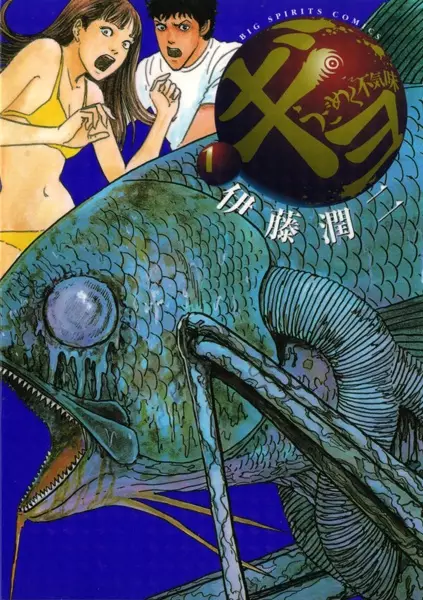
Gyo (en)
Here is a polished, spoiler-free overview for *Gyo* (English), written for a premium manga website.
---
### Gyo
**A Masterpiece of Cosmic Horror from the Mind of Junji Ito**
In the world of horror manga, few names inspire as much visceral dread as Junji Ito. With *Gyo*—often referred to simply as *Gyo (en)*—the master of the macabre delivers a two-volume tour de force that abandons the quiet, creeping terror of his earlier works for an all-out, apocalyptic assault on the senses. This is not a ghost story; this is a biological nightmare.
**The Premise: A Stench of Death**
The story begins with a young couple, Tadashi and Kaori, on a seaside vacation in Okinawa. Their romantic getaway is shattered when a bizarre and horrifying phenomenon emerges from the ocean: fish, long dead, are crawling onto land atop grotesque, mechanical spider-like legs. These "robot fish" are driven by a mysterious, putrid gas that infects everything it touches, transforming the living and the dead alike into monstrous, walking amalgamations of flesh and metal.
What starts as a localized horror quickly escalates into a full-scale invasion. As the stench of death spreads, so too does the infection, turning the beautiful coastlines of Japan into a wasteland of squirming, rotting abominations. Tadashi and Kaori are forced to flee a world that is literally coming apart at the seams, pursued by fish, sharks, whales, and even the ghostly remnants of the drowned dead.
**Atmosphere: Claustrophobic Chaos**
The atmosphere of *Gyo* is one of escalating, inescapable chaos. Ito creates a world where the rules of biology and physics have been broken. The air is thick with the stench of decay, the sound of clicking mechanical legs is a constant dirge, and every shadow hides a new, more grotesque mutation. The horror is not psychological in the traditional sense—it is physical, immediate, and overwhelming.
Yet, true to Ito’s genius, the terror is not just in the monsters. It is in the decay of society, the breakdown of order, and the horrifying implication that this pestilence might be more than a disease—it might be a *purpose*. The atmosphere builds from a survival horror into a philosophical dread, questioning the very nature of life